

EANS2025 Day 4
Congress Highlights: Notes from a Legendary Wednesday
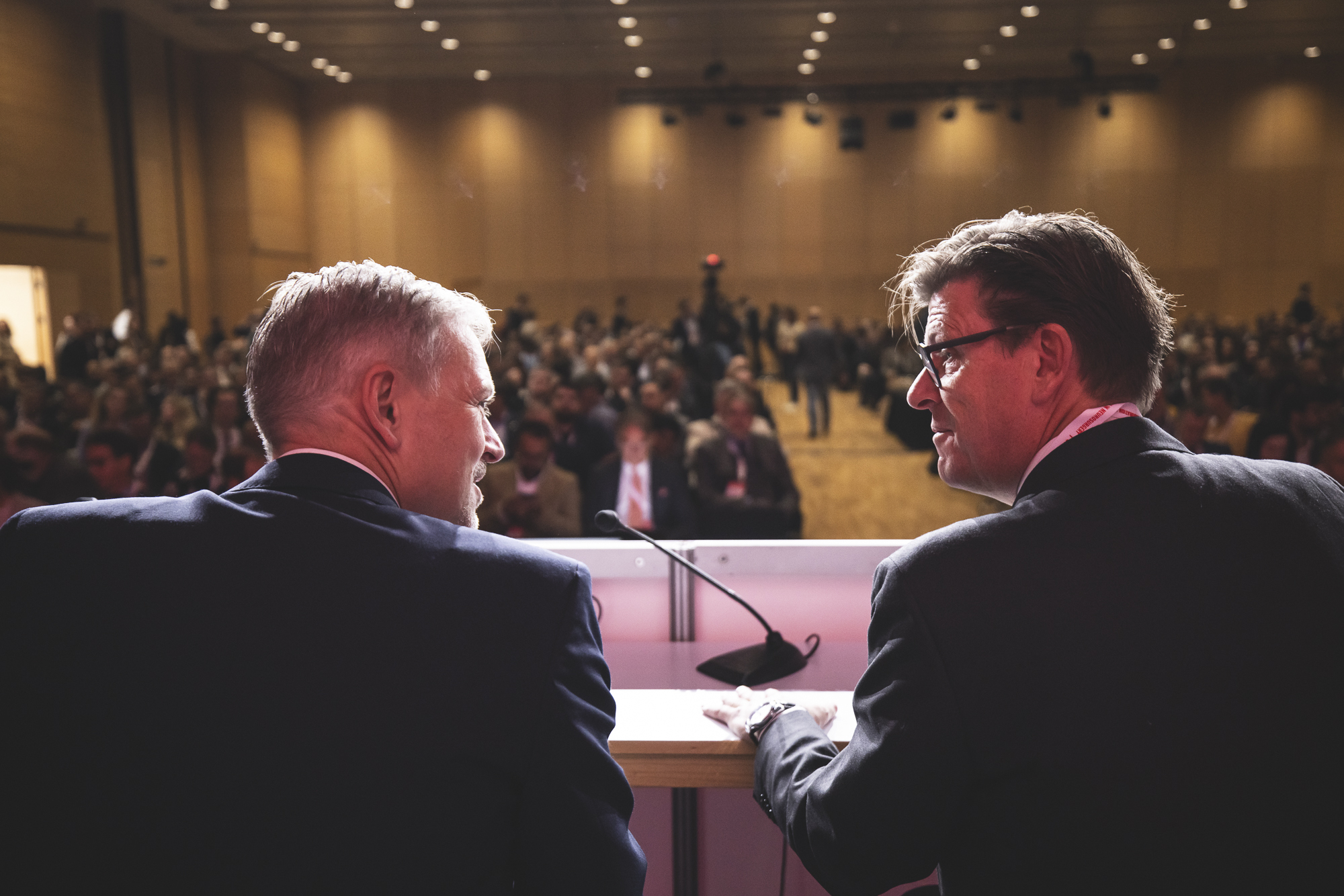
A great congress is nearing its end – but not quite yet! Potentially, the Viennese neurosurgical spirit, or why not a Vienna Skull Base approach, could be as famous as the Wiener Waltz. Let´s summarise Wednesday, shall we, and be inspired by the never-ending enthusiasm of the speakers, industry partners, and participants.
We started at 07.00 – truly the “early bird catches the worm” – and the day began strongly with brisk sessions in spine (cervical degeneration, trauma pearls), neuro-oncology (function-preserving resections, supramarginal strategies), and trends & innovation (AI, robotics, advanced imaging). Skull base focused on anterolateral corridors, and the functional parallel explored DBS refinements with attention to complications and outcomes. A Trauma Masterclass explored dementia/TBI trajectories, while CSF problem-solving offered practical endoscopy tips. Coffee time saw lively exchanges around chronic subdural hematoma data and education/Young Neurosurgeons’ initiatives in the e-poster zone.
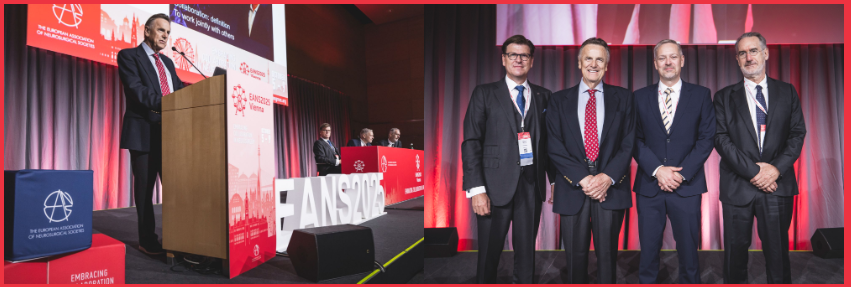
These morning sessions were followed by a Keynote Lecture by none other than the true neurosurgical legend Robert F. Spetzler. His impact in the areas of vascular and skull base neurosurgery cannot be overemphasised. He is the Emeritus President and CEO of the Barrow Neurological Institute, with publication and surgical records that are nothing short of impressive. He emphasised, among other things, the importance of collaboration, and reminded us that for hard-working neurosurgeons, it is crucial to dedicate time to friends, family and sports – despite the demands of a neurosurgical workload. The word “inspirational” summarises his talk, and he deservedly received a prolonged standing ovation for his contributions.
The Trauma plenary was nothing short of game-changing. Wilco Peul presented how the new TBI classification will change how we view and study our TBI patients in the coming years, since our current classification into mild, moderate and severe TBI does not sufficiently explain outcome prediction. Guy Rosenthal presented new penetrating guidelines that will be in press by Christmas. These guidelines are highly anticipated and important, not least in view of many global armed conflicts currently ongoing. In this congress, much wartime data has been presented compellingly by our Ukrainian friends. Then, Niklas Marklund addressed the topic of dementia risks and chronic traumatic encephalopathy in previous athletes, something often uncritically addressed in the media. These dementia risks should be weighed against the overall huge benefits of participating in sports. Then, Corrado Iaccarino elegantly elaborated on the potential role for basal cisternostomy in severe TBI, a procedure that has raised both critical questions and safety concerns. Finally, there were presentations from the two awardees selected for the best abstracts. Both were on chronic subdural hematoma, one by Jugoslav Ivanovic on novel medical management and Jehuda Soleman on the potential to avoid interrupting aspirin for chronic subdural hematoma surgery. Chronic subdural hematoma may not be as surgically challenging as skull base surgery, but there is certainly much to discuss!
Editor-in-Chief, Wilco Peul, gave an update on the Brain and Spine Journal- Impact Factor now 2.5 – excellent news for the EANS! The most cited paper in Brain & Spine “Blood Biomarkers in Traumatic Brain Injury- a narrative review of current evidence”- to date cited 32 times- was published by Iftakher Hossain at Imperial College Healthcare NHS Trust, London, UK. He gave a comprehensive summary of the rapidly expanding field of biomarkers in TBI management.
The lunch hours mixed dense e-poster traffic (advanced neuro-oncology imaging/monitoring, degenerative spine updates, adult CSF, global neurosurgery) with industry symposia. The industrial lunch sessions are an appreciated part of the congress since state-of-the-art scientific overviews as well as innovations and technical progress are presented, of gain to our neurosurgical work and to our patients. One keeps thinking how happy we are to live in an era of such achievements in neurosurgery where technological advances and clinical management refinements have merged. A visit to the exhibitors is truly exceedingly fruitful- and generates many ideas and possibilities. This means that while Vienna’s Opera House was part of a “Mission Impossible” movie, the Vienna Congress Center is home to a Neurosurgical Mission Possible.
The Spine Plenary started with Norbert Weidner presenting novel work on the treatment of Nogo-A inhibition for spinal cord injury (SCI). Is there finally a medical treatment available to promote recovery in SCI- the recent trial is based on cutting-edge basic science. It has now been evaluated clinically, with promising results to build on for the near future. Spine giant Bernhard Meyer then discussed the technical aspects of spine surgery, particularly the positioning of spinal patients. Patient selection and navigated minimally invasive techniques are the key. You wanted to know how to correct cervical spine deformity? Then the talk by Enrico Tessitore was perfect for you, where navigated-assisted techniques were nicely outlined. Some truly complex cases were on display here! And the talk stirred much interest – evident by the high number of questions addressed after his presentation. There were two best abstract presentations on highly relevant topics. First, Nadia Simoes de Souza compared foraminotomy to ACDF in the FACET study, including 265 patients. There were very few differences among the groups, with posterior foraminotomy non-inferior to ACDF, while it had a slightly higher frequency of recurrent symptoms and re-operations. Then, Maria Blagia presented her work on intraoperative vancomycin aiming at reducing surgical site infection in instrumented spinal fusion surgery.
The short plenary on Chronic Subdural Hematoma (CSDH) and MMA embolisation was highly attended, reflecting the huge interest in the topic. In this short, high-energy block on CSDHs examined where MMA embolisation belongs in the treatment pathways: primary therapy, adjunct to surgery, or for recurrence. Surgical, endovascular, and combined strategies were weighed with a focus on patient selection, as well as safety and costs. First, Jiri Bartek, Jr, reported on the consensus work and the rather conflicting data that exist on the efficacy of MMA embolisation for CSDH. Jildaz Caroff then presented several important technical and anatomical aspects of the procedure, crucial for the safety of the procedure. Regarding this rather novel procedure, there are numerous unsettled questions and controversies. No one could address these uncertainties better- and more critically- than Rahul Raj, raising the scientific level of the topic. Finally, Nikolay Velinov reported on the indications for endovascular treatment, arguing that MMA embolisation can be used for first-line treatment in certain, selected patients. Could combined embolisation and drainage in one setting be the best alternative? Overall, this session navigated the field in a scientifically-oriented direction on when to use, and not to use, MMA embolisation and where data are currently lacking.
This year, there were an unprecedented number of abstracts and those of you that attended Wednesday´s poster sessions learned much about neurosurgery. Participants enjoyed the “off the typical neurosurgical topic” afternoon presentations on history and education, areas of key relevance for neurosurgery, and the posters on neurotrauma, spinal cord injury and neurocritical care also received deserved attention. The use of earphones, novel to this EANS Congress, clearly improved the overall quality of the e-poster presentations.

In the afternoon, there were many presentations with relevant and novel findings. This included 6 parallel sessions on vascular (unruptured aneurysm risk and repair), neuro-oncology (rare & extra-axial tumors), radiosurgery (pediatric AVMs), Intraoperative neuromonitoring (IONM; facial-nerve preservation in CPA surgery–surgeon–neurophysiology teamwork), ethics & international law (global collaboration without legal blind spots), and young neurosurgeon (AI in education and practice) topics. In addition, there were two masterclasses (CSF neuroendoscopy; updates in pediatric brain tumours). As we waltz through one corridor after the other, knowing there are many fascinating talks ongoing, we wonder how Viennese Sigmund Freud would have treated our indecisiveness regarding which talk to attend. Perhaps a session on his famous couch, on how to make difficult decisions, would have been needed! There was an excellent session on unruptured aneurysm. While these entities may be “easier” to operate on than when they have ruptured and the brain being “angry”, the increasing detection of unruptured aneurysms on routine neuroimaging raises questions on when to operate, or when to follow. The talks included e.g., prediction of adverse events, reports from an UK study (the ROAR study), how to follow unruptured intracranial aneurysms (and for how long), adverse events and which patients who are at risk of an unfavorable outcome.
As the congress draws to an end, we should acknowledge the tremendous work of recent and incoming presidents- Andreas Demetriades, Torstein R. Meling, Francesco Sala and Claudius Thomé- since their importance cannot be overestimated as they shape the focus, collaborations and future of European neurosurgery. We all closed a day that balanced technique, systems thinking, and real-world implementation. The spirits of the congress remain high- like the Viennese St. Stephen’s spire- and hopefully all enjoyed Vienna at night while remaining sharp for the final hours of the congress on Thursday.
EANS Functional Neurosurgery Section Initiatives
The Functional Neurosurgery Section consists of a group of 15 panel members, who are renowned European neurosurgeons dedicated to the fields of Epilepsy Surgery, Deep Brain Stimulation (for various indications), and Surgery for Pain and Spasticity.

The Section is highly active in multiple areas, including the creation of an attractive scientific programme for the annual EANS Congress, as well as the organisation of Joint Symposia with members of sister societies, like the ESSFN, and with other EANS sections.
A key initiative of the Section is the EANS Epilepsy Surgery Hands-on Brain Dissection Course, which takes place annually.
This is a three-day course dedicated to Epilepsy Surgery. The course, offering both a basic and advanced level of training, is open to a maximum of 16 participants (5th-6th year trainees and young neurosurgeons). Participants receive theoretical lectures and practical supervision during brain dissection from over 20 renowned European and American epilepsy surgeons.
For the past two years, the course has taken place at the Anatomy Lab of the University Hospital in Vienna. It will also be organised in Vienna in 2026, and individual EANS members interested in Epilepsy Surgery are strongly encouraged to apply.
Further activities include the participation of section panel members in the EANS training courses for Functional Neurosurgery.
Last but not least, since training and education are among the key goals of the section, we have organised annual webinars featuring 2–3 keynote speakers in the field of Functional Neurosurgery. These experts discuss surgical approaches, new techniques, and emerging developments under the guidance of a moderator.
Upcoming Webinars
- 19/11/25 – LEATs: Considerations from an Oncological and Epilepsy Surgery Perspective
- 26/11/25 – How to Start a Functional Neurosurgery Service
Every EANS individual member is welcome to become a member of this section and is encouraged to actively contribute!With gratitude,
EANS Functional Neurosurgery Section
New ethico-legal challenges for ever-expanding
neurosurgical frontiers
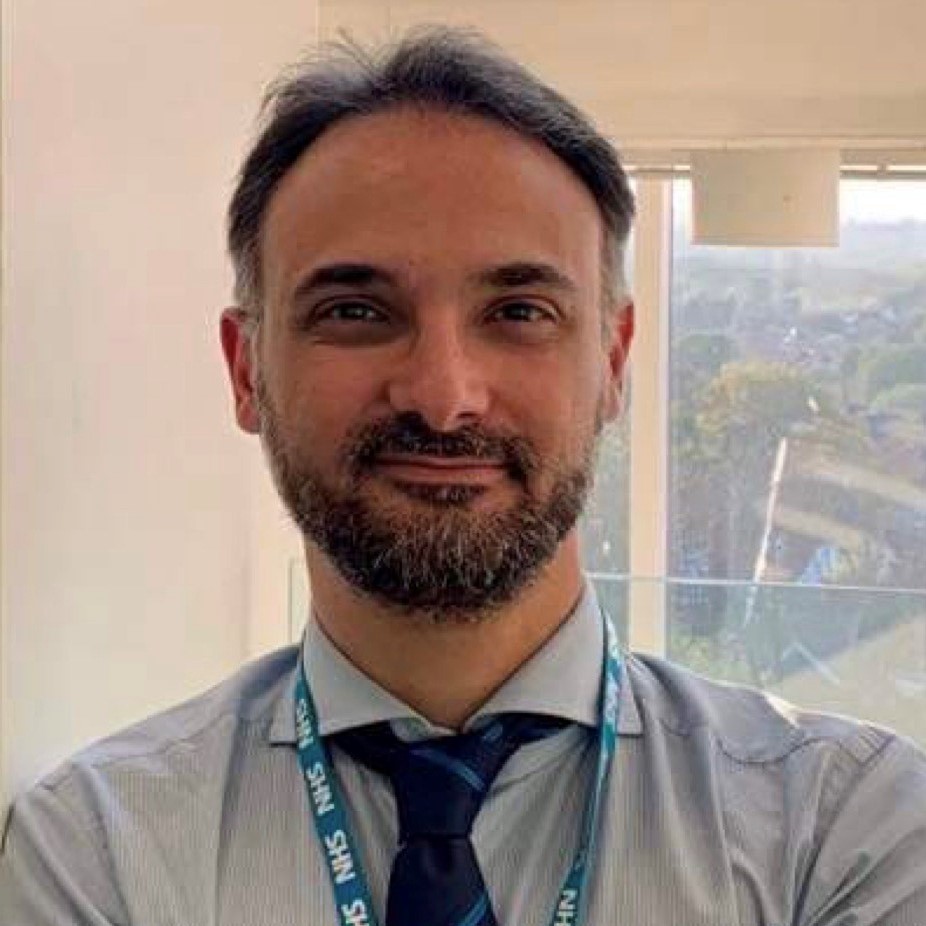
The Ethico-Legal Committee continues to engage with discussions across the EANS family on how to tackle new challenges posed by the ever-expanding technological revolution that is impacting our professional lives.
Over the past year, this has led to the preparation of scientific manuscripts in collaboration with the Young Neurosurgeons’ Committee and the Examination Committee, which explored how artificial intelligence could change our approach to academic work, clinical dilemmas and even in the preparation of written questions for the European Board of Neurological Surgery examination. All publications, so far, have been indexed in Brain and Spine, which allows effective dissemination and impact through its open access model.
Throughout the year the second pillar of our work consisted of organising educational events where ethico-legal matters affecting our subspecialities could be discussed with experts from within and outside the EANS family. This effort has led to the preparation of webinars with the Global and Humanitarian Committee and Paediatric Section, with high volume of registrations and live attendees. More importantly, the Ethico-Legal Committee has joined forces with the Serbian Neurosurgical Society and will be actively involved in their annual congress scheduled for the 23-26 October in Novi Sad, where the following themes will be covered: Digital Health, Patients’ Safety, Medico-Legal Responsibilities, Professional Standards, Moral Values, etc.
The EANS is going through exciting times: with new challenges come greater opportunities for the expansion of our horizons, and the Ethico-Legal Committee remains committed, now more than ever, to reflect on them all and provide timely answers to the Board and to all our international members. For the first time, we have expanded our footprint in EANS2025, where we will be chairing one plenary and two parallel sessions; this is a threefold increase in our usual contributions to previous annual congresses. Along with our contribution to the preparation of an EANS Professional Standards Guideline, this contribution to the Annual Congress demonstrates the mandate given to us by the EANS Board. Hence, join us in Vienna, bring your questions and propose new solutions, and we will be there to listen!
The Ethico-legal Committee
Hamburg Reception Brings Warm Welcome and Excitement for Next Year’s Congress
The EANS2026 Hamburg Reception took place during the EANS2025 Congress, bringing together delegates for an enjoyable networking event. Attendees shared drinks, lively conversations, and received small gifts, offering a glimpse of what awaits in Hamburg next year.
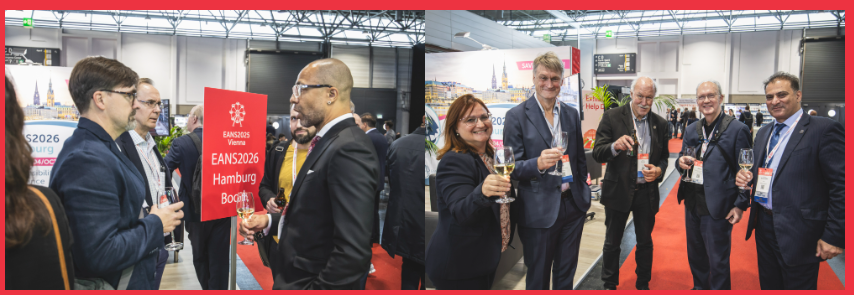
Professors Manfred Westphal and Veit Rohde, Co-Chairs of the EANS2026 Congress, personally welcomed guests to the booth. Amid a warm atmosphere, they shared their enthusiasm for the upcoming event and extended a heartfelt invitation to all participants to join the EANS2026 Congress, which will take place from 30 September to 4 October 2026 at the CCH – Congress Center Hamburg.
EANS Lifetime Achievement Award, Bernhard Meyer & Claudius Thomé
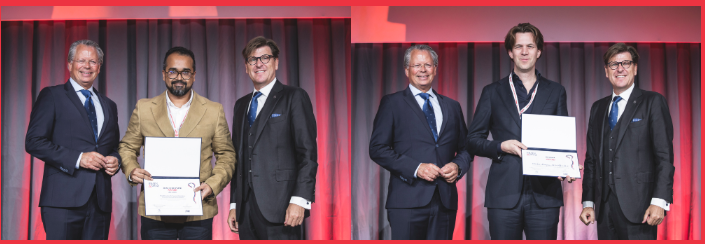
During the EANS2025 Congress, EANS honoured Prof. Bernhard Meyer, Professor of Neurosurgery (Munich), with the EANS Lifetime Achievement Award for his remarkable contributions to the field of neurosurgery. The award was presented by Prof. Claudius Thomé, President of the EANS2025 Congress. Following the presentation, Prof. Thomé engaged in a discussion with Prof. Meyer about his selection and the significance of the award. Watch the full interview!
EANS Dialogues – EANS Lifetime Achievement Award, Bernhard Meyer & Claudius Thomé
EANS Award for Exceptional Service to European
Neurosurgery 2025: Hugues Duffau & Johannes van Loon
During the EANS2025 Congress, the EANS honoured Dr. Hugues Duffau and Prof. Johannes van Loon with the EANS Award for Exceptional Service to European Neurosurgery in recognition of their outstanding dedication and long-standing commitment to the neurosurgical community.
EANS Award for Exceptional Service to European Neurosurgery 2025: Hugues Duffau & Johannes van Loon
Win a Free Registration to the EANS2026 Hamburg Congress!

Get a chance to win a free registration for the EANS2026 Congress in Hamburg. The steps are easy:
1. Snap a photo
2. Share it on your social media (LinkedIn, Instagram, Facebook, or X) using the official Congress hashtag #EANS2025
3. Ask your friends to vote for you by liking your post on the EANS2025 Social Wall
The post with the most likes on the EANS2025 Social Wall will win free registration to the Congress. Don’t miss out — Hamburg is waiting!
Now is the time to join the EANS family – a colourful, open, diverse, ever-evolving, and always on-the-move neurosurgical community.
Follow us on Social media and
stay tuned for the rest of the Journey!
